Delayed Milestones in Babies & Toddlers | Brave Bodies
Watching your baby learn to roll, sit, crawl, stand and eventually take those first few steps is an exciting part of the first few years of parenthood.
It can also be surprisingly stressful.
If you have ever watched the Bluey episode “Baby Race”, you will probably recognise the feeling. The mums compare when their babies rolled, crawled and walked, and suddenly every milestone starts to feel like a competition — even when nobody really means it to.
It is funny because it is so relatable.
Should they be sitting by now? Why aren't they crawling like the other babies at playgroup? Is it normal that they're not walking yet?
The first thing we want parents to know is that developmental milestones aren't exact deadlines. There is a normal range for when children develop new skills, and two healthy children of the same age can progress quite differently.
However, there are times when a baby or toddler is developing movement skills more slowly than expected, has difficulty performing particular movements, or begins moving in a way that is noticeably different.
From a physiotherapy perspective, these are worth paying attention to.
What Are Developmental Milestones?
Developmental milestones are skills children progressively develop as they grow.
During the first three years, development happens across several areas, including:
Gross motor skills such as rolling, sitting, crawling, standing, walking and running
Fine motor skills such as reaching, grasping and using objects
Communication and language
Social and emotional development
Play and problem-solving skills
As paediatric physiotherapists, we focus particularly on gross motor development and the way a baby or child moves.
Rather than looking at one milestone in isolation, we're interested in the bigger picture.
Is your child progressing from one movement skill to another? Are they using both sides of their body? Do they have the strength, balance and coordination needed for the next stage of development?
Australian developmental guidance also emphasises that milestones are a guide rather than a strict timetable. Children generally develop skills in a similar sequence, but the exact age at which they achieve them can vary.
Movement Milestones From Birth to 3 Years
There is a broad range of normal development, but having a general idea of the progression of movement can help parents recognise when their child may benefit from further assessment.
Around 3-6 Months
During these early months, babies are beginning to build the foundations for later movement.
You may notice your baby:
Developing better head control
Pushing through their arms during tummy time
Reaching towards toys
Bringing their hands together
Beginning to roll
Becoming more active with their arms and legs
Tummy time and supervised floor play are particularly valuable during this stage because they allow babies to develop their neck, shoulder, trunk and upper-body strength.
Around 6-9 Months
Movement starts becoming much more purposeful.
Babies may begin to:
Roll in both directions
Sit independently
Reach for toys while sitting
Pivot or move around on the floor
Push through their arms
Begin experimenting with ways of moving towards objects
Some babies begin crawling during this period, while others take longer.
Around 9-12 Months
This is often a busy stage of physical development.
You may see your baby:
Sitting confidently without support
Moving between sitting and lying positions
Crawling or finding another way to move around
Pulling themselves into standing
Standing while holding furniture
Beginning to move sideways along furniture
Not every baby crawls in exactly the same way, and some children use alternative methods of getting around before walking.
What matters is understanding why your child is moving the way they are and whether they are continuing to develop strength, coordination and independence.
Around 12-18 Months
For many toddlers, this is when independent walking begins.
During this stage toddlers may also begin:
Standing without support
Squatting to pick up toys
Walking while carrying objects
Climbing onto low furniture
Experimenting with faster walking or early running
Again, there can be considerable variation.
A child who isn't walking at exactly 12 months isn't automatically delayed. We look at their overall development and the skills leading towards walking.
Around 18 Months - 2 Years
Once walking becomes established, toddlers begin refining their balance and coordination.
You might see:
More confident walking
Running
Climbing
Kicking a ball
Squatting during play and standing again
Attempting stairs with assistance
Carrying or pulling toys while walking
Around 2-3 Years
Movement becomes increasingly complex as strength, balance and body awareness develop.
Children may begin to:
Run more confidently
Jump
Climb playground equipment
Walk up and down stairs
Kick and throw balls
Negotiate uneven surfaces
Participate in increasingly active physical play
By this stage, movement is also becoming increasingly important for independence, play and participation with other children.
When Might a Delayed Milestone Be Worth Checking?
A milestone arriving a little later than another child's doesn't necessarily mean something is wrong.
What can be more useful is looking for patterns in your child's development.
From a physiotherapy perspective, we'd encourage parents to seek advice if they notice things such as:
Difficulty developing head control
Significant difficulty with tummy time
Not progressing towards sitting independently
Difficulty putting weight through the arms or legs
Consistently using one side of the body more than the other
An unusual or very asymmetrical crawling pattern
Difficulty moving between positions independently
Not progressing towards standing or walking
Frequent falling beyond what you'd expect for their stage
Walking consistently on their toes
Movement that appears unusually stiff or floppy
Losing a physical skill they could previously perform
You might also simply have a feeling that something about the way your child moves isn't quite right.
That observation matters. Parents spend more time watching their child than anyone else. You don't need to wait until you're certain something is wrong before asking for professional advice.
Not Crawling Yet? It Doesn't Always Mean There's a Problem
Crawling is one milestone that creates plenty of discussion among parents and it is often one of the first things that sparks that Baby Racefeeling.
One baby at mothers' group is crawling across the room, another is pulling to stand, and suddenly you find yourself wondering whether your own baby is "behind".
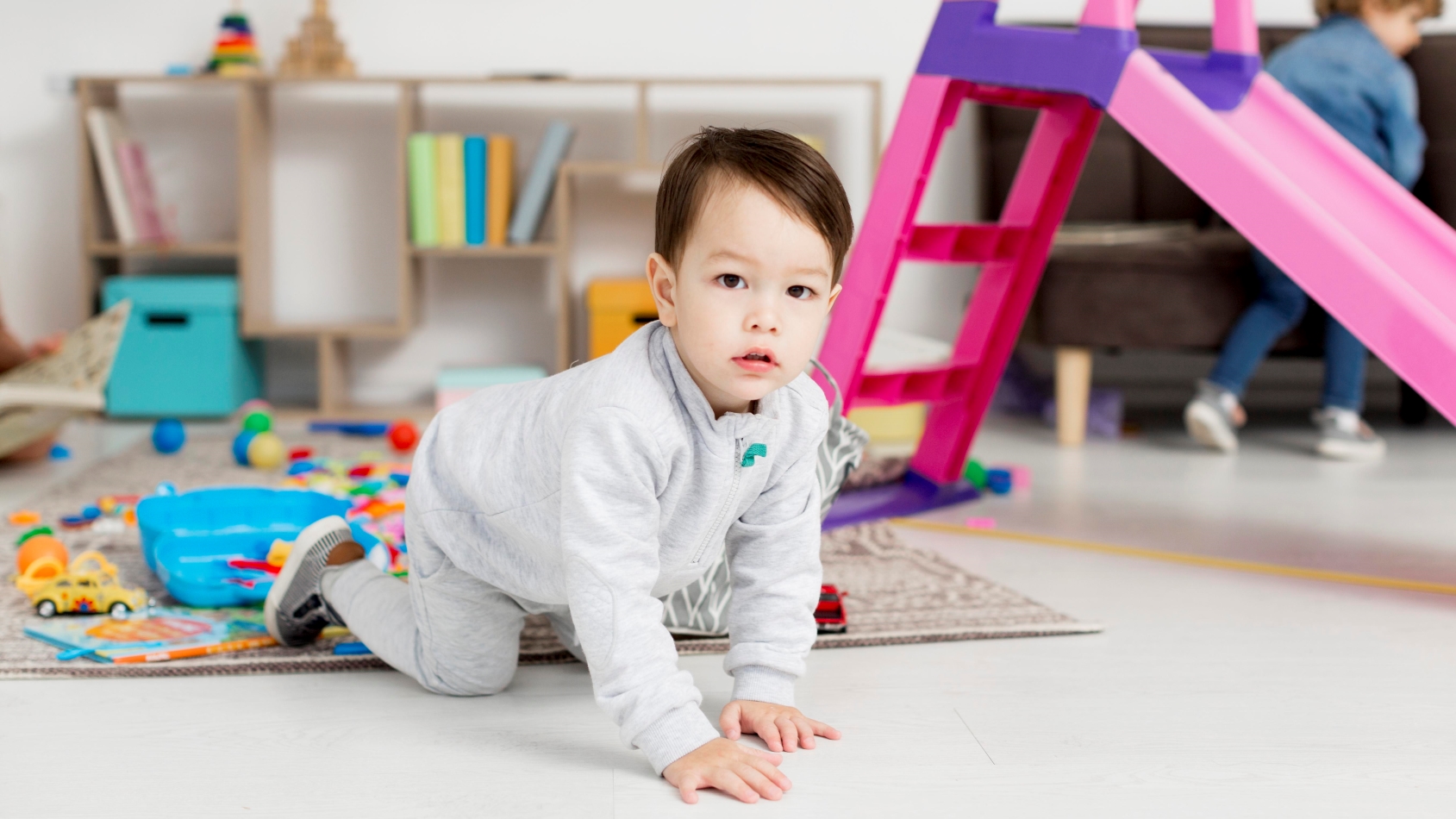
Some babies crawl early. Others crawl later. Some bottom shuffle, commando crawl or develop another way of travelling across the floor before eventually standing and walking.
Rather than focusing only on whether a child is crawling by a particular month, a paediatric physiotherapist considers the bigger picture:
Can they move independently?
Can they transition between positions?
Are they using both sides of their body?
Are they developing trunk and shoulder strength?
Can they bear weight through their arms and legs?
Is their movement becoming progressively more complex?
Sometimes a different movement pattern is simply part of that child's development.
At other times, it gives us useful information about their strength, coordination, joint movement or overall motor development.
What If My Toddler Isn't Walking Yet?
Walking has a particularly wide window of normal development. Many toddlers begin independentlywalking somewhere between 12 and 18 months. If your child isn't walking yet, we don't simply look at their age. We look at what they can do.
For example:
Can they pull themselves into standing?
Can they stand while holding furniture?
Can they move sideways along the couch?
Can they lower themselves back to the floor?
Are their legs becoming stronger?
Are they progressing?
If the underlying skills are developing, your child may simply need more time.
If those building blocks aren't appearing, an assessment can help identify what might be making walking more difficult.
What Can Cause Delayed Gross Motor Milestones?
There isn't one single cause of delayed movement.
Sometimes a child simply develops at the later end of the typical range.
In other cases, gross motor development can be affected by factors such as:
Reduced muscle strength
Low or high muscle tone
Joint flexibility or stiffness
Balance or coordination difficulties
Premature birth
Torticollis
Plagiocephaly
Differences in neurological development
Genetic or medical conditions
Limited opportunities for floor-based movement and active play
Sometimes there isn't an obvious cause at all.
The purpose of a physiotherapy assessment isn't to attach a label to every difference. It's to understand what is making a particular movement difficult for your child and what we can do to help.
How Can a Paediatric Physiotherapist Help?
A paediatric physiotherapy assessment is very different from an adult physio appointment.
At Brave Bodies, our physiotherapists specialise in working with children and use play to observe how a child naturally moves, interacts and explores.
Depending on your child's age, we may look at:
Head and trunk control
Strength
Balance
Coordination
Muscle tone
Joint movement
Sitting and standing balance
Rolling and crawling
Transitions between positions
Walking and running
Symmetry of movement
How your child responds to different movement challenges
Most importantly, we look at these skills in the context of your child and your family's goals.
Our therapy is play-based because play is how young children learn.
Rather than expecting a toddler to perform repetitive exercises, we might use toys, games, climbing, reaching or different positions to encourage the movement we're working towards.
You can learn more about our Paediatric Physiotherapy services and how we support babies and toddlers across the South West.
What Can Parents Do at Home?
You don't need a house full of developmental toys to support your child's movement.
Some of the best opportunities come from ordinary play.
Depending on your baby's developmental stage, this might include:
Supervised tummy time
Plenty of safe floor time
Placing toys slightly out of reach to encourage reaching or movement
Playing in different positions
Allowing babies opportunities to move without spending long periods restrained in seats or equipment
Encouraging toddlers to climb, squat, push, pull and carry during play
Playing outside on different safe surfaces
Rolling, throwing and kicking balls
Giving children time to try movements independently before immediately helping
Australian physical activity recommendations encourage babies to have supervised, interactive floor-based play throughout the day, including tummy time while awake, while toddlers benefit from plenty of active play and opportunities to explore movement.
If we're working with your child, we'll also show you practical activities that can be built into your normal routine rather than giving you an unrealistic list of exercises to somehow squeeze into an already busy day.
Early Support Doesn't Mean Something Is "Wrong"
This is an important distinction.
Seeking advice about your child's development isn't the same as receiving a diagnosis.
Sometimes a physiotherapy assessment provides reassurance that your child is progressing appropriately and simply needs more time.
Sometimes we identify one or two areas where some targeted play and strengthening could make movement easier.
And sometimes an assessment helps identify that further investigation or support from another health professional would be beneficial.
Either way, having more information can be much more useful than spending months wondering.
Paediatric Physiotherapy Across South West WA
Brave Bodies was created specifically to improve access to specialised paediatric allied health services for families living in the South West.
Our AHPRA-registered paediatric physiotherapists and occupational therapists work exclusively with children and provide family-centred, play-based care.
Families can access clinic appointments in Busselton, Margaret River and Bunbury, along with mobile physiotherapy services across areas including Busselton, Bunbury, Dalyellup, Vasse, Margaret River and Dunsborough.
For babies and toddlers, being able to assess and support movement in a familiar environment can also be particularly useful. Brave Bodies offers appointments at home as well as in clinic, depending on your family's needs.
Concerned About Your Baby or Toddler's Development?
If you've noticed a milestone hasn't arrived when you expected, your baby seems to be struggling with a particular movement, or you simply have questions about their physical development, you don't need to work it out alone.
At Brave Bodies, we've supported hundreds of South West families with concerns about their child's development. Our approach is to listen first, assess what's happening and give you a clear understanding of what - if anything - needs to happen next.
You can start with a free 15–30 minute Discovery Call with Brave Bodies. There is no obligation and you don't need to know whether your child needs physiotherapy before getting in touch.
Sometimes the next step is therapy.
Sometimes it's another health professional.
And sometimes it's simply reassurance that your little one is doing just fine.
Book a Free Discovery Call with Brave Bodies to discuss your baby's or toddler's development and find the right next step for your family.
1. What are the most common signs of delayed milestones in babies?
Signs can include difficulty with head control, not progressing towards sitting or crawling, avoiding weight-bearing through the arms or legs, using one side of the body much more than the other, or not progressing towards standing and walking. A single milestone being late does not always mean there is a problem, so it is important to look at your child’s overall movement and development.
2. When should I be concerned if my baby is not crawling?
There is a wide range of normal development, and some babies crawl later or use different ways of moving, such as bottom shuffling or commando crawling. It may be worth seeking advice if your baby is not moving independently, is very asymmetrical, is not bearing weight through their arms or legs, or is not progressing towards other movement skills.
3. When should a toddler start walking?
Many children begin walking independently between around 12 and 18 months, although development varies. If your toddler is not yet walking, a physiotherapist will usually look at the skills leading up to walking, such as pulling to stand, cruising along furniture, standing balance and leg strength.
4. Can a paediatric physiotherapist help with delayed developmental milestones?
Yes. A paediatric physiotherapist can assess your child’s strength, balance, coordination, muscle tone, joint movement and gross motor skills. Therapy is usually play-based and may include practical activities that help your child build the skills needed for sitting, crawling, standing, walking and active play.
5. Do I need a referral to see a paediatric physiotherapist in South West WA?
In most cases, families can contact a private paediatric physiotherapy service directly without a GP referral. If your child is accessing support through the NDIS or another funding pathway, there may be additional requirements. Brave Bodies can help families in Busselton, Bunbury, Margaret River, Dunsborough and surrounding South West areas understand the most appropriate next step.